Vernissage:
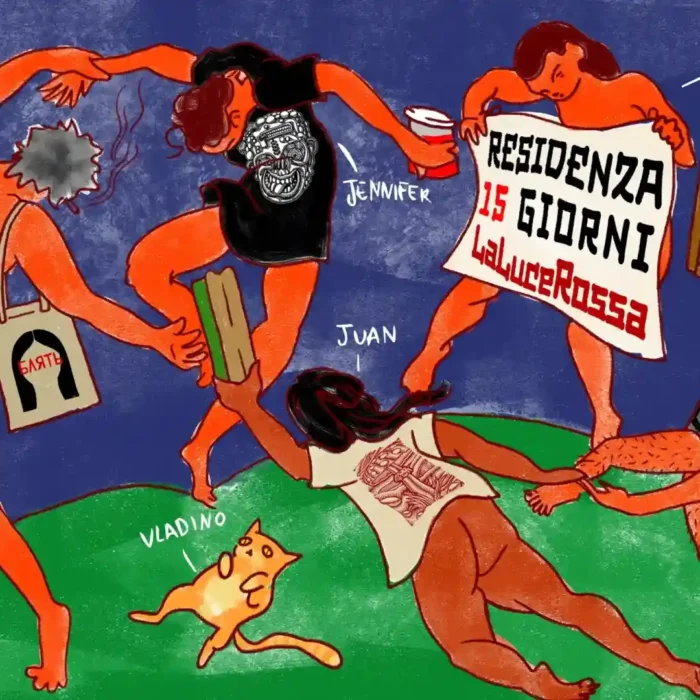
Friday 09/09/2022 at 7:00 PM
Tekè Gallery – La Luce Rossa
Via Santa Maria 13, Carrara (MS)
Info: juanca@tabularasa.it
Tel: +39 3343035848
Exhibition duration: from 09/09/2022 to 09/11/2022
The La Luce Rossa Screen Printing Workshop, under the direction of Juan Carlos Allende, in collaboration with Tekè Gallery, presents “Memorie della Polvere”: a solo exhibition by Maria Ginzburg.
Born in 1998, of Russian origin, the artist resides in Antona, Massa Carrara; she holds a degree in Painting from the Academy of Fine Arts in Rome. She is currently collaborating with Yourban 2030.
 The collaboration began in October 2020. Juan and Maria decided together to create a work dedicated to the Apuan Alps, bringing to light a powerful reflection on the imminent ecological disaster, caused by human activity, that we are currently experiencing.
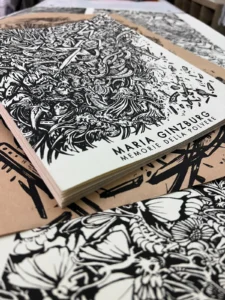
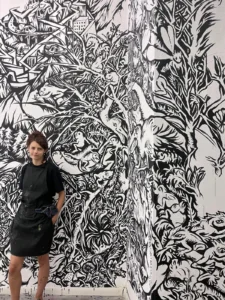
From this came the works now exhibited in the gallery: a mural on the walls of the first room, with a sound piece by Alessio Mosti aka a.m.soundscapes, the original illustration for the leporello (a concertina-style book), its hand-screen-printed copies, and 50×70 cm prints, also screen-printed by hand using marble dust. The journey concludes in the third and final room, where it will be possible to see the place in which this remarkable project was born.
The artist’s research is dedicated to the Apuan Alps and to all those landscapes that, for trivial reasons linked to private profit, are at risk of disappearing. Her intention is to highlight the problems caused by a system that compromises the complex balances of nature, of these mountains, victims of mass production.
The exhibition also emphasizes the passive acceptance, by the community, of permanent damage to this collective heritage, which took millennia to form and can no longer be restored in the future.
The underlying thread of the work is the latent memory of calcium carbonate, the material that forms marble. It appears as dust, born of a life cycle and a millennia-old history of transformation and continuous structural modification that led to the creation of mountain chains. In the present day, this material, obtained from marble blocks ground into dust, is no longer seen as a waste byproduct but has become an object of speculation: about 75% of the marble extracted is processed by multinational corporations and destined for industrial use.
 The works in the exhibition, aiming to recount the dual path of this material, offer two different narrative directions: on one side, the extremely slow pace of marble’s natural, evolutionary history, and the complexity that made its formation possible; on the other, the destructive actions of humans and the speed with which extractive processes irreparably and lethally damage the landscape.
The visible contrast between these extremes shows the long-term consequences of harmful and selfish human behaviors, offering an opportunity for ethical reflection and personal accountability regarding the issue of pollution, and proposing an alternative perspective.
A perspective in which education in environmental sustainability becomes a central and essential core, offering coordinates to guide more conscious daily choices through the development of an active and engaged critical awareness.
Cultural investment enables real emancipation from profit-driven and exploitative logics, in which harmful consumer dynamics generate waste and a lifestyle aggressive toward the planet. All of this leads to reflections on the possibility of creating a new way of conceiving shared and private space, in light of alternative solutions that ensure genuine well-being, expressed through a respectful and harmonious coexistence between humans and their surroundings, where well-being is not merely hedonistic but is found in the real, tangible improvement of quality of life.
The meaning of our existence on this planet lies in the indispensability of empathy and cooperation. From a global perspective, it becomes clear that the ethical sense of our everyday life can only be acquired by recognizing ourselves in the “other,” whether it be the natural world of vegetation and animals, or humanity itself.
In conclusion, the journey traced through the pages of “memorie della polvere” seeks to affirm the indissoluble bond that ties human beings to the environment, starting from an analysis of the processes of life’s creation and highlighting how the loss of the true meaning of inhabiting is the primary cause of the planet’s inner distress.
Seabeds. In the shadow, life. Blind, groping tentacles, corals, long fingers with no hands.
Cold eyes in cold bodies, smooth forms brushing past, intertwining underwater.
Marine creatures. And then... breath.
Paws, limbs, legs, supports, tendons, knees. Wings. Lives of light, of green, of thirst.
Beaks, scales, feathers, fur, teeth, ears... Bare skin.
Everything is created, everything is destroyed.
A metallic noise tears through vision. A man of thirst, of hunger and money.
Creaking is heard, frantic rummaging of mechanical arms, panting gnawing of iron jaws.
Warm wood, trees, nature and bare rock collide with the violent human touch
tormented by the desperate urge to feed the craving.
Bites. Bites into the stone that crumbles quickly. Roads, wheels, steel, excavation.
Deep holes, cavities in the mountains. Construction, building, engines.
Smoke... dust... rhythm... production. Clothes are hanging out in the open air.
Air of exploitation. Air of torment. Wooden crosses planted in the ground.
After obsession, harassment, delirium, greed...
Rest.
Darkness carved into the earth.J.T.
They say today that
by listening to a seashell
you can hear its song;
place your ear and listen
to what we are losing.G. M.
DISINTEGRATE
“D” is the sound work produced by Alessio Mosti for the piece “La memoria della polvere” by Maria Ginzburg. It is a soundscape that follows a parable of construction and deconstruction of sound. While a melodic mantra repeats throughout much of the track, there is a distinct self-generating phase of organic creation, and one of artificial mechanical deconstruction. This symbolizes the phase in which human beings, intoxicated by technological progress and scientific advancement, forget fundamental principles such as interaction and interdependence. One soon finds oneself in the descending phase of the arc, in which one can do nothing but witness the desolate disintegration of the surrounding environment. The intoxication of omnipotence thus gives way to a bitter sense of frustration. The sound piece also incorporates a microphone installation in the gallery, through which the sound of visitors’ footsteps becomes part of the audio being played.
For information: